Songs without Words (Lieder ohne Worte) is a series of short lyrical piano pieces composed by Mendelssohn between 1829 and 1845. The compositions were part of the tradition of lyrical short piano pieces of the Romantic period, although the specific concept of “Songs without Words” was a new one. Mendelssohn’s sister Fanny (1805-1847) composed a notable number of similar pieces, although she did not title them as such, and, according to some historians, was involved in the development of the concept. However, the title “Song without Words” is in all probability Mendelssohn’s own invention.
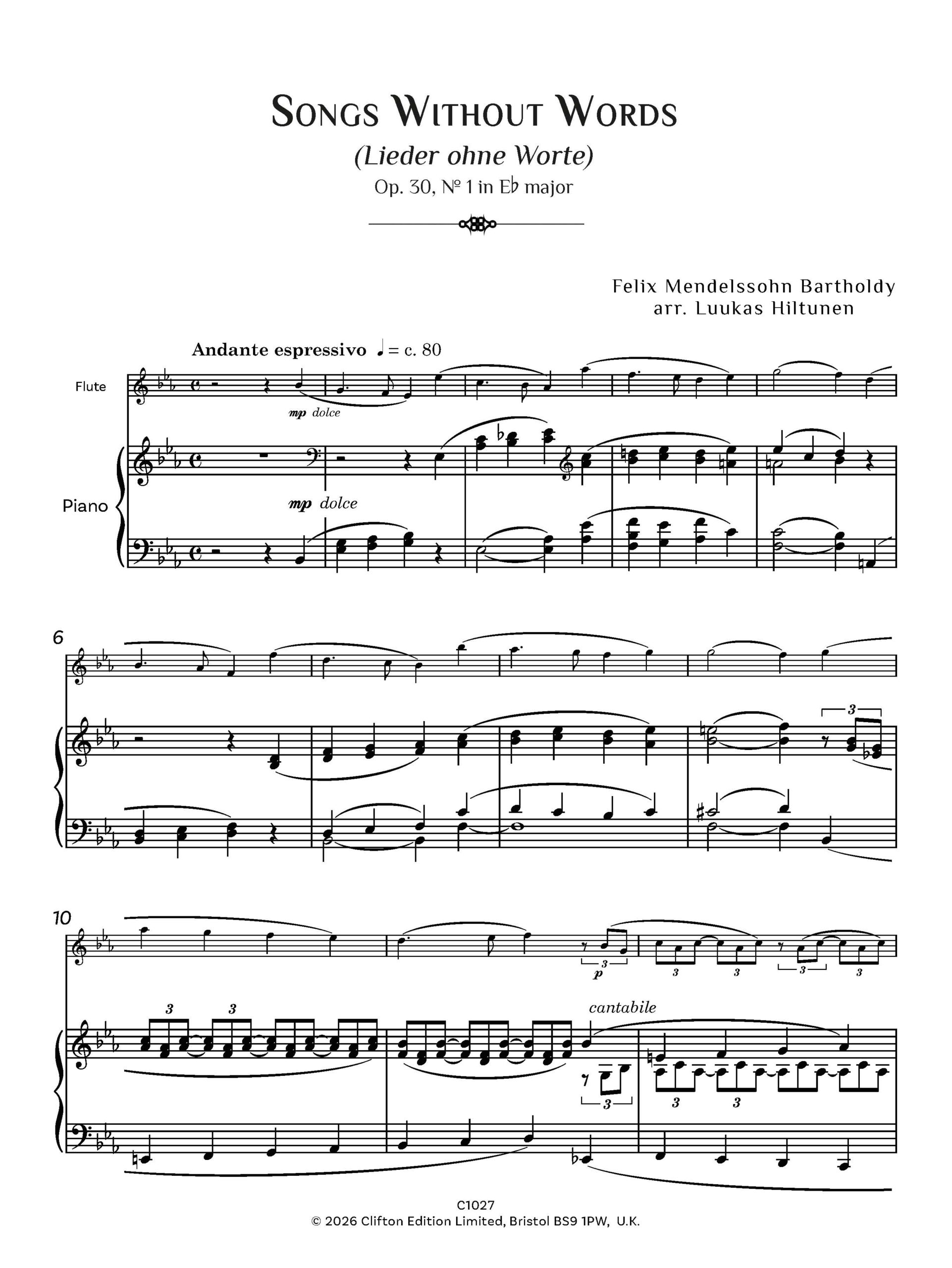
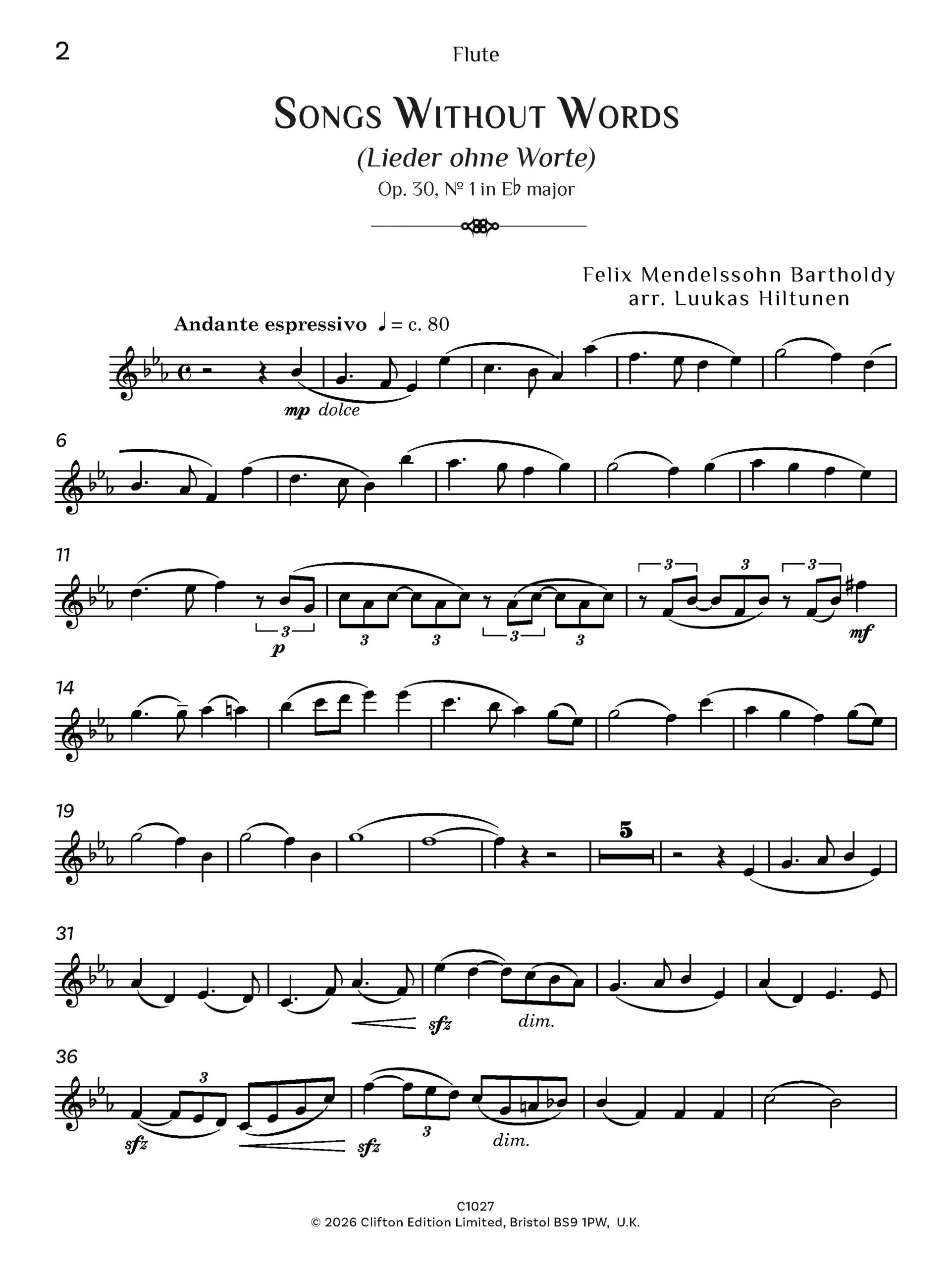
The present Song in E flat major, Andante espressivo, MWV U 103, arranged here for flute and piano, is the first of the pieces in the second book of Op. 30, which Mendelssohn composed between 1833 and 1834. Op. 30 was the first volume to bear a dedication to Elise von Woringen, a daughter of Düsseldorf’s judge at the Court of Appeal and supporter of the composer. Although Mendelssohn himself did not arrange any of his Songs without Words for a solo instrument with a piano accompaniment, he did arrange a number of songs for piano duet, songs which later comprised the fifth volume and the first of the sixth. Many others have made various arrangements of individual songs, including for orchestra, chamber ensemble, or solo instrument with piano accompaniment. One such example is the arrangement of 22 of the songs by Mendelssohn’s student, the German violinist Friedrich Hermann (1828–1907), for violin and piano.
I decided to approach the arrangement with the idea of how Mendelssohn himself would have adapted his Song for flute and piano. Through my nearly four-year reconstruction process on the composer’s unfinished Sixth Symphony in C major, his musical language and way of composing became internalised, which is why the arrangement was accomplished effortlessly in about one week. A straightforward transposition of the original to solo instrument with the melody-accompaniment principle hardly ever produces a satisfactory outcome, which is why it was decided to extend Mendelssohn’s Song with an introductory passage, a recitative section in the coda and an extended conclusion. The sustained opening of the introductory passage, before the triplet-accompaniment commences, is inspired by the similarly tranquil openings of Mendelssohn’s Reformation (1830, revised 1832) and Scottish (1829-1842) Symphonies. Measures 21 and 22 are already foreshadowing the accompaniment rhythm that Mendelssohn composed before the forte transition by the piano in measures 23-28. A brief two-measure sedative and soothing phrase in quarter-notes on B-flat leads the music into Mendelssohn’s own melody and the first strophe of the Song. When the melody is repeated in measures 40-50, it is raised an octave higher while the piano texture remains unchanged. As for the notes in low B-flat in the coda at measures 71 and 74, I consulted not only Aminoff but also two other flautists, Tuuli Orasuo and Saara Latvanen, to determine whether it would have been possible to perform the notes, which were penned by Mendelssohn. Unfortunately, this proved impossible, as there is no accessory that can be installed in the Western established concert flutes to facilitate this. However, the note has been retained in the edition to indicate Mendelssohn’s hand. The recitative section beautifully encapsulates the Song’s sentimental atmosphere, while the four-measure conclusion includes a triplet ascension in a typical Mendelssohnian manner and a decorative ending on the last fermata note.
Luukas Hiltunen
Tampere, July 2024
YouTube Video
Anna Aminoff, flute
Inge Spinette, piano
Recorded at the Ruovesi Church (Sofia Magdalena Church), Ruovesi, Finland, on 27 June 2025